


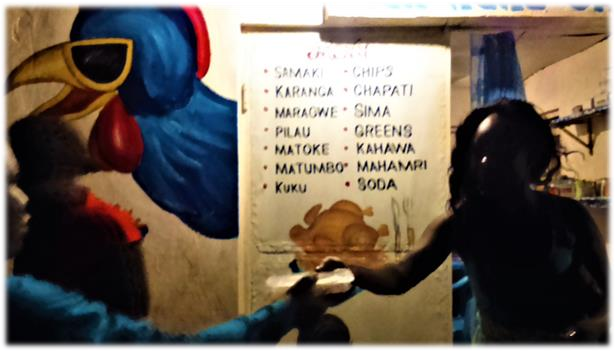
A blue kuku adorns the shop front and is the standout feature in this area, known locally as Mkoroshoni. Blue is the predominant colour of the façade, which boasts the café menu and hand-painted examples of mouth-watering foods on offer inside.
For those unfamiliar with the Kiswahili language used on the coast of East Africa, kuku means chicken in English. But why blue? No one seems to know, apart from the fact that Blue Kuku Café has a nice ring to it and perhaps the thought that people in time might come to say: “Let’s all meet at the Blue Kuku”. There may also have been some fleeting thought of serving kuku with blue food colouring added … quickly discarded! Who in their right mind would want to eat a blue chicken?
The dusty street onto which the blue metal doors open is typical of the wider Shanzu locality, or Shanzu Village as some call it; typical that is, of an informal settlement, more commonly referred to as a slum. A narrow, uneven dirt road, which turns into a river when the rains come, the rushing water depositing washed sand on the ground as it storms past the café. Later, the sand dried by the hot sun, turns to a golden colour, inducing Rhumba a local teacher, to praise the heavens above, as he scrapes the deposit from the street to add to his concrete mix.
“God is so good to us people in Shanzu; see how he gives us all this free sand!”
Rhumba is typical of the folk from this Mkoroshoni community, a potent mix of people, with representatives from most tribes in Kenya and even from neighbouring Tanzania. He is a small man in his late twenties and reasonably happy with the lot he has been allocated in life: a roof over his head at nights and a job which returns enough money for him to buy the essentials for survival, including a daily meal of chapatti and beans at the Blue Kuku Café.
To get to know something about the ways of life in an African slum we can focus on the café for a while, its workers and its customers and the array of happenings that govern their daily lives: some good, some bad, and some which can only be described as horrific! This includes people like Rhumba, who are happy with what they have been bequeathed by their forebears … and The Almighty.
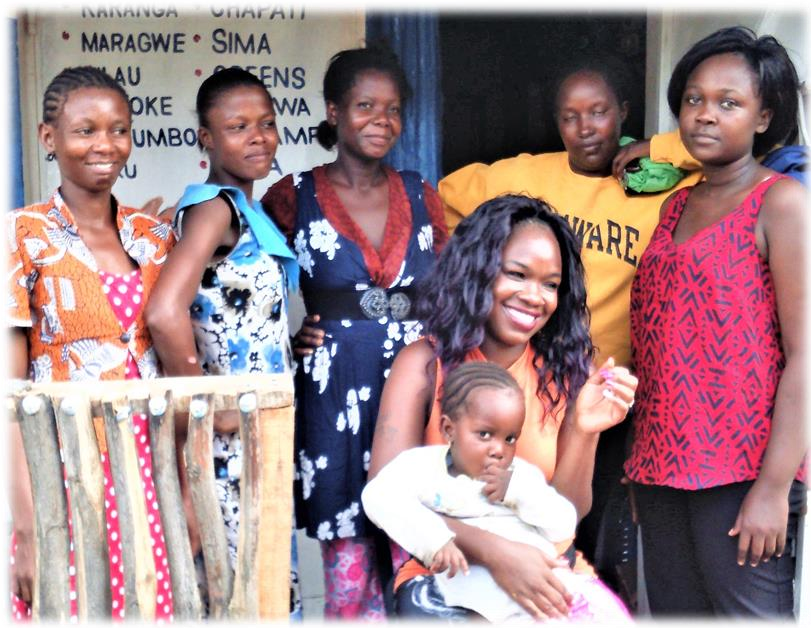
Manager Emily, staff and customers outside Blue Kuku.
They are downtrodden and underprivileged; exploited by the rich and servants of the middle classes, but most, believe this is their status quo and nothing can be done about it: just get on with life as we know it and try to be as happy as possible in the given circumstances.
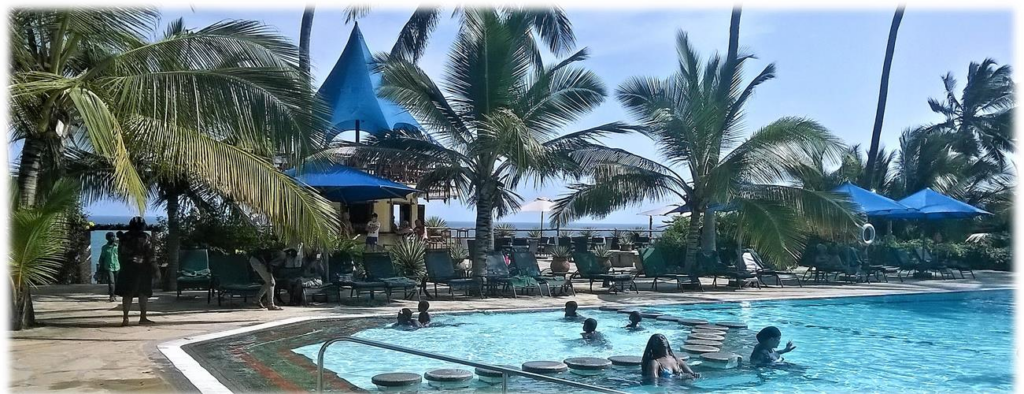
Blue Kuku also connects, from time-to-time, to a world beyond the either dusty or flooded streets of Mkoroshoni. For it happens that just a kilometre or two away stand the palaces of the rich: the tourist hotels, clubs and bars that decorate the nearby tropical beaches of Kenya and play host to seasonal visitors from Europe, North America, and (more recently) Asia. This juxtaposed world is where the young men and ladies of Shanzu go to work in the tourist season; the men as labourers and waiters, the women as cleaners and to sell their bodies to the rich and famous! Sometimes the men also sell their bodies, and at times both men and women can hit the jackpot by snaring a visitor from the North as their short, or even long-term partner, which acts like an ejector seat from a jet fighter, propelling them up, up, and away from the poverty they once knew as Shanzu.
Daily life at Blue Kuku begins before sunrise and continues through to late evening. Habiba, the mainstay of its small workforce, is there every day at five in the morning to open the doors, clean the place and fire up the kitchen stoves. These quite basic jikos (small cookers) are made locally out of recycled metals, in what is known as the jua kali (literally under the hot sun) industry. They provide intense heat from a variety of fuels (depending on price and availability at the time) including charcoal, brought in from nearby rural areas, or sawdust, the left-over product from local woodsheds. Soon after the sun rises from the sea, over this still sleeping street of Mkoroshoni, Habiba is joined by her co-worker Eunice and café manager, Emily.
Preparations for the day start in earnest, with cooking of mahamri, a sweet yet spicy donut type of delicacy, popular as a breakfast snack here on the African coast. There is a sequence to the foods and drinks that are cooked and consumed as the day progresses, beginning with mahamuri and progressing to chapati (a flat, round, delicious bread) consumed with masala chai (the traditionally spiced, sweet and milky tea), then to more substantial dishes of meat, or fish, or beans with greens, usually served with rice, for lunch and dinner. Of course kuku, of the non-blue variety, is available as what might be termed the flagship dish of the café.
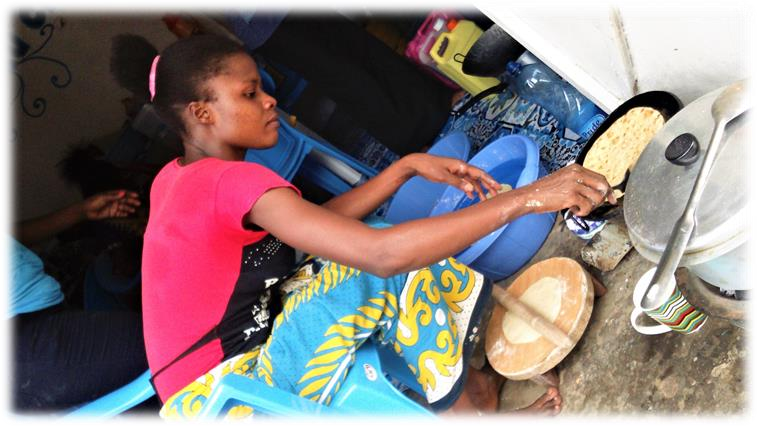
Eunice, a staff member, cooks chapati.
The café itself is very inviting, consisting of two small shops, each about fifteen square metres, and each with a wide doorway opening onto a concrete veranda, covered with rather rusty mbati (corrugated iron) sheeting. One of the spaces is used predominantly as the store cum preparation area: where the delicious pastries like mahamuri, chapatti and samosas are made, along with more substantial dishes, such as pilau, matoke and matumbo. The food is then cooked outside on the small jikos then served to customers in the ‘dining room’ next door.
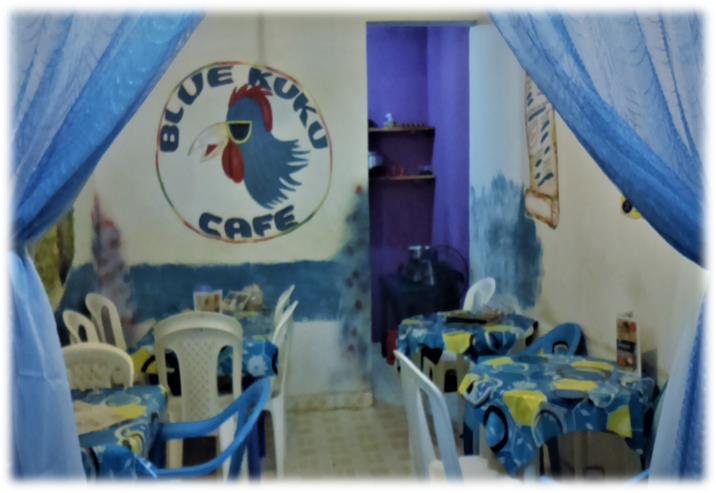
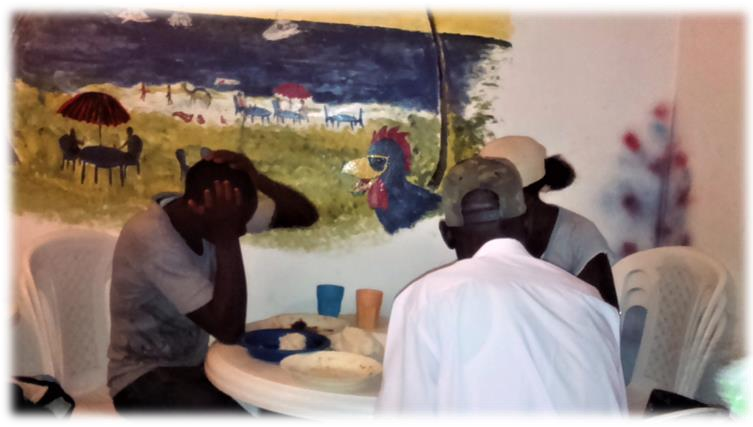
The dining room has four small tables, in blue of course, to match the Blue Kuku theme, with a couple of extra tables on the veranda outside. Enough seating space in total for about twenty guests. As an overflow, at times when business is brisk, regular customers know there is also table space in the kitchen area, though when the jikos are up and running, it’s an understatement to say that this can be a fairly warm option; but not something that would worry too many locals:
“Hakuna matata, bwana (no worries, sir),” they might say, “We are well used to the tropical heat, your kitchen is no different!”
Both kitchen and dining area boast a large, iconic Blue Kuku mural, to amuse those sampling the gastronomic delights. The idea, as shop manager Emily remarks, was stolen from a cornflakes packet! Moses, the local sign writer, commissioned for this unusual job, displays hidden talents for transposing this chicken wearing sunglasses, to the walls, ten times the size of the original. In the dining area he has also painted a mural of the local Serena Beach. The prodigious painter, who works all around the area, likes to drink a little palm wine – the local brew harvested from the coconut palms and sold as a cost-effective commodity in palm wine dens – but as long as the night before wasn’t too late, he can be relied on to produce a formidable work of art.
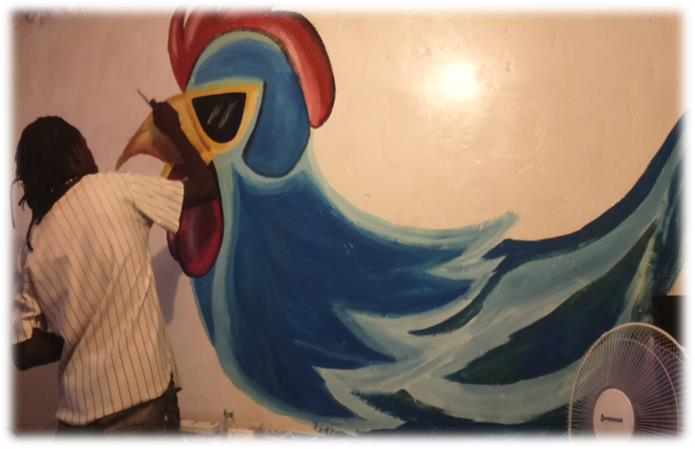
Artist Moses applies finishing touches to the Blue Kuku.
Though the café is clean and brightly coloured, it really is a simple place, especially when compared with up-market bars and restaurants not so far away, on the beachfront. However, some of the locals consider it an amazing place to chill (in the heat!) and often come to do just that. One of them – an undeniably rotund lady – famously saying:
“Please give me another plate of chips, Emily, I can’t bear to leave this place and go home to my own house; Blue Kuku is soooo beautiful!”
The Shanzu community sits just south of the equator, where the sun is high in the sky all year round. There is limited respite from the intense heat during the winter months – June to August – when daytime temperatures drop into the twenties. Wet spells coming before and after the cooler period – May and October – at times seem almost monsoon-like, bringing heavy rains and flooded roads, as well as a whole range of more intimate challenges for the poor of Mkoroshoni. This is when the dry and dusty street outside the café suddenly turns into the rushing waters of River Shanzu, as locals jokingly call it! But apart from the easing of temperatures in winter and the seasonal rains, which are generally quite short, Blue Kuku in the main exists within a hot and humid, tropical climate, with the sun high up above and glaringly bright.
At either end of the day the surrounds seem to exude a special kind of ambience: in the early morning, before the heat starts to build as the street awakens, and from dusk through evening, when the air becomes quite still as beams of light from small electric bulbs under the veranda’s roof take over from the faded sun. In this early evening period, the humidity seems to build again for a while, bringing with it a languid and relaxed atmosphere. This is a special time for the locals when they like to drop by for a meal or a snack, to sit for a while and to tell their stories. And because the melting pot of people visiting Blue Kuku is so wide and varied, the stories they tell reflect a wonderful diversity of backgrounds and upbringing.
Sounds are another aspect to savour at Blue Kuku, especially in that early evening when the air is still and voices carry up and down the street, bouncing off the iron and stone buildings on either side. Children sit in the middle of the road, playing in the sand, as boda bodas (motorbike taxis) beep and steer around them. Young ladies, colourfully dressed, chat and laugh, standing in groups of three or four; voices building to a crescendo of excitement and clapping of hands as they discover a juicy piece of gossip. Men can be seen holding hands whilst discussing highlights of the day, usually in hushed tones, unless a man like our flamboyant teacher, Rhumba, is there to steer discussions in more electrifying directions.
With all these sounds joining together in some sort of un-orchestrated street symphony, amid the smells of different foods wafting from the jikos on the veranda, the atmosphere, as evening approaches night, takes on a whole new meaning, which embodies perhaps what community life can be all about, whatever our station in life.
But of course, it is not all like that: there is another side to this happy story from Blue Kuku. At times we need to replace our rose-coloured glasses with very clear and unblinkered lenses, to see what life is really like, behind the scenes in the village of Shanzu. For the truth is that most people in Mikorishoni live in dire poverty, which means they exist close to the edge of a precipice; never knowing when they might actually disappear over that clifftop, towards an even worse situation.
Five dollars a day is not that much to feed, clothe and school a family, but it is possible if frugal. That in fact is quite a reasonable salary for a person working at a beachfront hotel. Some may make more, but for many it will be less. But when the daily income drops to, let’s say, two dollars a day it becomes a real, almost impossible, struggle to survive…literally! There’s rent to pay – and $1 per day buys an extremely basic bedsit – then there’s essentials of electricity and water, before we even start on food and transport and school fees, etc. And there is no safety net!
All this brings with it a certain degree of tension. On occasions tempers boil over and ladies can be heard screaming at each other; the crowd can even turn on one of their own and beat her if they feel she has digressed seriously enough, maybe by stealing, or perhaps mistreating a child. For people trying to scrounge a living for themselves and their family with virtually no income, there is a high level of stress and quite often a low level of trust. Such a mix brings potential for heightened tension, with jealousy and aggression never far from the surface.
