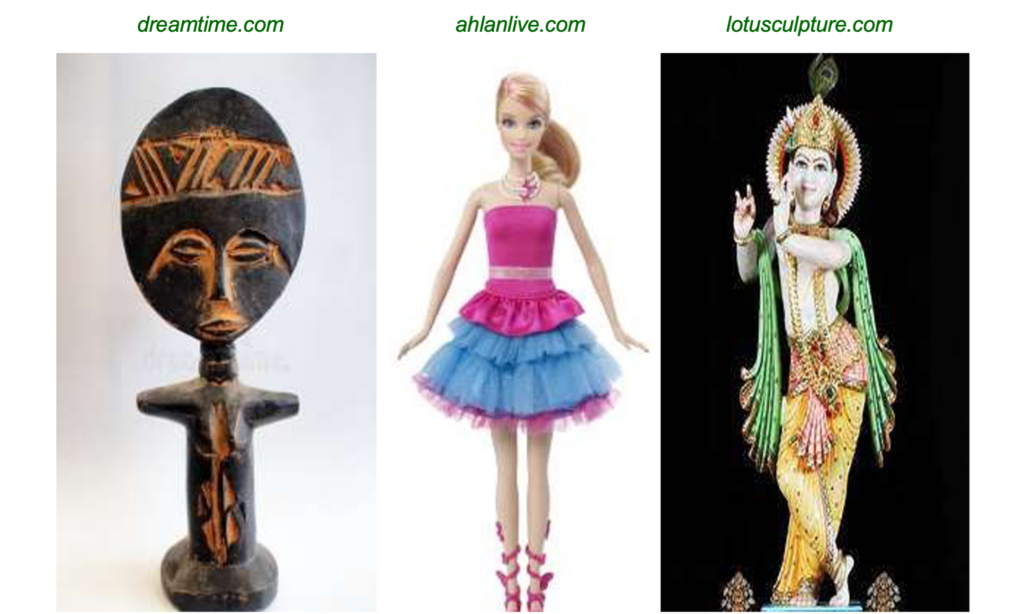
It was a strange looking humanoid object, carved from dark wood with stretched neck and bulging eyes: E.T. for the classroom! I never quite worked out its purpose (past or present) but the kids adored it. This was a mysterious item from faraway Africa, unlike anything they had ever seen before. Was it a centuries old voodoo doll? We will never know. But it did lay unused in my attic for several years, presiding over family strife and financial disasters.
Edwina, as we named our E.T. lookalike, was star of the show: on parade along with a range of other items, there to help a class of English eight-year-olds understand a distant and very different way of life in Africa. At times, a very real Edwin was also present: a Kenyan youth studying at a local college, who would join me on our joint mission, to introduce African culture to British children. He also captivated the kids: tall and slim, with jet-black skin, typical of the Luo Tribe from the shores of Lake Victoria.
It was a method I had begun to use a decade before, to help Australian pupils empathise with counterparts in India; and in reverse, when visiting schools in India or Kenya, where
I would carry a range of items from the culture of the so-called First World. At the time it seemed to work well, the children being especially attracted to video footage made by their equals from other lands. In retrospect I might well have been criticized for emphasizing the differences, rather than levelling the playing field; in essence: Voodoo Dolls from The South versus Barbie Dolls from The North. Criticism justified, though it was generally much better than that.
The target group in the early days was the seven to eleven age: those most formative years for the future. It was the focus age for Kids Contact magazine, which I edited and produced for Australian schools, and thus the age group from where I derived the source material. When I started out in Australian and Indian classrooms there was no computer backup; no PowerPoint, or anything very much that resembles the learning aids we have today; often no electricity either, at one end. For portability and ease of working, I started out with a clutch of A3 photos and a posse of supporting paraphernalia. Keep it simple stupid, is a phrase which resonated. In this case it worked.
The methods and aids we used evolved as time moved forward. Whiteboards and computer-sourced projection replaced blackboards and overhead transparencies. India did its best to keep up with the west, though schools in rural areas lagged far behind.
Kenya was slower, but even there, the available tools began to improve and progress. In later years, when I became more involved at a university level, the gulf in technologies was becoming less noticeable.
Now, I find it slightly unnerving to think my work in education spanned a total of about 30 years: my mid to late life choice. Then I wonder if it did in fact involve logical choice, or was it something which just evolved, mostly beyond my control. Whichever, it began in Asia: Australia and India to be more exact. Then after returning to Britain, the work developed into triangular initiatives, run from UK and incorporating India and Kenya. The third and final phase was solely Kenyan.
Across those three decades I worked with colleagues from four countries to develop methodologies for use at all levels, targetting trainers, teachers, children and youth. Quite ingenious stand-alone components were also able to fit together like pieces of a jigsaw, forming one coherent whole. One of these techniques, developed in Kenya, was a simplified method for mapping the school’s local community.
At that time, we were working in conjunction with a group whose main focus was to map indigenous communities in extraordinary detail, with the aim of finding what was lacking and what needed to be improved. This intricate procedure spanned a couple of weeks during which they would actually form up a massive, 3D table-top map of the location, including hills, valleys, roads and rivers, down to fine detail, such as beehives and bore holes. It was a fascinating method to watch evolve, and I vividly recollect sitting with members of an indigenous group known as Yakku (a small branch of the Maasai), at the ceremony to commemorate completion of the model. The sound of several hundred Yakku tribesmen, with their deep, monotonous, humming beat, was captivating to say the least … even hypnotic!
Thus I borrowed the basics of this complex modelling technique, for classroom use in much simpler form. Students drew their route from home to school, showing places they passed on the way. This laid the foundations for vigorous discussion; what it meant to live in that place: the highs and the lows. The maps and thoughts could then be used to discuss ways to improve the status quo, and then – through overseas school connections – could also be passed on to people in other cultures, as a learning tool to encourage an understanding of alternative perspectives, and inspire empathy.
Much later, when work focused more towards tackling climate change, we developed this method into a finer art. It began with five or six children around a table, drawing a detailed map of their location, with the school at the centre. Groups would then discuss and label places on their map – green, amber or red – signifying positive, negative or somewhere-in-between gradings. This became what we termed the Traffic Light, showing places where good things were happening, as opposed to locales of extreme
danger. Examples might be a health clinic (good – green) or pollution from a factory (bad
– red). Between extremes there were many amber ratings that warranted attention.
This was a simple but excellent learning tool, which formed the core for later education work. I was excited to watch proceedings in the classroom as children discovered their own community and what they could do to make it better … and later to view on TV, as our Traffic Light Technique was broadcast to the country! I always remember – amongst a range of other examples – footage of Mary, a nine-year-old from Thika, taking ideas of vegetable growing and rabbit rearing back to her family in the adjacent slum.
Early forays into Western Kenya were not without incident, and in fact kept on being not- without-incident for more than a decade. Usually it was money at the root of the problem. At the start I was naïve and not up to speed when it came to wheeling and dealing with Africa. I remember one meeting when four of us sat at a square table: two Kenyans and two mzungus (the Kiswahili term for whites). I had accused one of the Kenyans of embezzling funds received from the UK, the other was there as a local adjudicator. Kevin, a British acquaintance, sat in as helpful observer. The meeting became seriously heated, but in the end nothing was decided. The stolen funds were never returned. I was sure of my facts, but the Kenyans knew that a cover up of illicit dealings was par for the course and there was little anyone could do about it. A taste of my first of many African stalemates!
A year or so later, Kevin – the Brit at that stormy meeting whose expertise was in the I.T. field – agreed to help with installation of computers and training of participants for a new three-way university programme, which I was managing. At one stage, I invited him to assist in choosing students for visits to India and Britain. The overall group had been identified, but at this final selection meeting we couldn’t understand why the Kenyan project manager seemed intent on pushing for certain people to join the UK-bound group. Later, over a beer, daylight dawned: she had been intent on securing places for students from her own tribe, as part of the delegation to Britain. Another lesson in the
politics of Africa … and a particularly Kenyan example. Colonialism may have been judged to be bad, but connections with Britain today are still highly valued.
In retrospect – and something we didn’t pick up at the time – was that as well as tribal affiliations, those preferences shown by the project manager were also symptomatic of an intrinsic dislike of Indians living in Kenya, a sort of veiled apartheid, where Indians frequently dominate the business sector with ruthless abandon. This was the beginning of my understanding of the complexities of African life and ways of doing things: often quite different and sometimes diametrically opposed to what I had been used to.
One day, on the job in the university (and not so long after our enlightenment with regard to tribal interplay) Kevin approached me, obviously quite troubled:
“Look George, it’s a great project, but I’m sorry I cannot work anymore with the lady in
charge here. She’s a nightmare.”
I could certainly empathise: the person in question was notoriously late for classes, decidedly biased when it came to tribal affiliations (as already described) and quite unreliable in terms of money matters. At one stage we had to suspend funding because the financial accounting from Kenya was so unreliable. But though Kevin was in a position to leave, I certainly could not. I had to hang in there …and learn to deal with it! The frustrating part of all this was that the lady in question was extraordinarily personable and oozed charisma. She was a tremendous asset when it came to large gatherings, but let herself and everyone else down regarding the detail.
The university-based project operated in Kenya, as well as India and the UK. And apart from small glitches – like the Kenyan accounting – it was a huge success: as good in many ways as anything we did before or after. It ran for three years, with the highlight each year being an international conference, including delegations from the other two countries. Kenya was the first host nation and showed the Kenyan manager at her best, both behind the podium and at the front of the tour bus, as we visited treasures of the region, including national parks and tea plantations, volcanic craters and hot springs.
The second-year conference in the UK was also a big success, though with some issues around accommodation, as it turned out when I arranged – for budget reasons – that staff would have rooms in the same area as students, and would use common bathrooms.
“But what if I meet the VC coming out of the shower, dressed in a towel?” One student from Kenya asked with a quaking voice.
“Well, at least that’s better than meeting him without a towel,” I replied a little too frivolously and perhaps without enough due respect for African protocol.
But the highlight of the three flagship events was quite definitely the final conference, which was held at an exclusive hotel outside Mumbai, in the Western Ghats of Maharashtra. It was remarkable for a start because though it was a 5-star place, we seemed to get the whole lot at 2-star rates. This was largely due to the contacts and negotiating skills of people managing the Indian arm of the project, and I well recall sitting alongside one of them as she negotiated prices with a hotel head. As the prices went down and down on a pleasing trajectory, I wasn’t game to say a word, in fear that I might somehow put my foot in it, causing the prices to shoot up again, like a share bonanza in a bull market. India and Indians can be amazing too!
The Indian conference was held in early January 2004, delegations having flown in from Kenya and the UK about a week before. In Mumbai I found Four Seasons, a reasonably priced hotel on Juhu Beach, which became our base for the first week and from whence there came a raft of problems that were mine to solve. Some of the UK party were unhappy with the accommodation, others homesick, while most were uptight about the frequent delays and changes to schedule. In the end we arranged a rooftop meeting to thrash this out, trying to explain that things in India were different to the UK, and even to Kenya (though the Kenyans insisted they could keep time much better than the Indians, which of course I knew was wishful thinking and utter rubbish!). The whole episode demonstrated the very integral aspect of seeing things from another’s perspective, which was the core of what the project was all about.
I guess Kenya grew on me, or perhaps I grew to understand more of Kenya as time went by; so much so that after about ten years as UK-based coordinator, I decided to live there. Thus Nakuru – a provincial town in the Great Rift Valley – became my first hometown in Africa. In hindsight this was perhaps an unfortunate choice, when just months after arriving, the town became infamous as the centre of violence following the 2007 election. For Kenya it was a turbulent time: more than 1,500 dead and half a million displaced. For me, it said a great deal about being in the wrong place at the wrong time, perhaps forecasting what was to come a few years later, when I would be caught in the Westgate Nairobi terrorist attack! It also took me back to a time in Mumbai, when I had been marooned for days in a hotel, during the Ayodya troubles of the early 90s.
Nakuru was the hot spot because it was peopled, in the main, by two of the warring tribes: Kalinjen and Kikuyu. Both were known to be ruthless and could kill if pushed; particularly a very fundamental and violent wing of the Kikuyu tribe: the Mungiki. The nights were bad with dusk to dawn curfew, violent police action and fires blazing all around, while daytime held different threats, such as women being stripped, or worse raped, by Mungiki members for showing bare skin or wearing western-style jeans.
I was booked to fly to London on the last day of that year – just as the whole confrontation was exploding out of control – and scheduled to return about three weeks later. Getting to Nairobi was the first hurdle, so with no public transport working, I managed to secure a taxi-ride all the way there, accompanied by my Kikuyu partner. Her tribe controlled the main Nakuru-Nairobi highway, a decided advantage. If she had been from another tribe it would have been far too risky. We holed up in Nairobi for a couple of nights, then made a dash for the airport, on New Year’s Eve. That was perhaps even more scary than the journey from Nakuru, because we were fearful that our taxi driver may have been bribed to fake an ambush. But all went well, and I left Kenya a few minutes prior to the end of that year.
The return journey three weeks later was somewhat surreal; I was one of just 40 passengers tramping around a large Jumbo, watching and listening to the BBC news footage beaming forth, with the ominous title: NAKURU GOES UP IN FLAMES! There was a noticeable comradery amongst those aboard, as if we were all flying into a war zone, which of course we were!
“I must be mad,” I said to myself, “To be flying back into that fucking mess!”
Thanks to the late Koffi Annan, the warring parties negotiated some sort of power sharing arrangement a month or so after I returned. The rightful winner of the election had it stolen from him by the incumbent Kikuyu leader; those displaced lived in UN tented camps, some for years after; six people were sent to trial at the International Criminal Court in The Hague (including the future president and vice-president); and the grieving buried their dead. No serious trial or enquiry happened locally; things just went back to a kind of post-war norm. This again was Africa: shovel everything under the carpet and move on. But I always felt that Kenya never fully appreciated what Koffi Annan did for them, as the UN special envoy. Without him it could have been civil war!
Soon after, I moved both home and work to Nairobi; it had become a large, reasonably cosmopolitan city and was indeed a safer place to live than Nakuru, should there happen to be any resurgence of tribal infighting. We built on the experiences from the three-way university programme and from 2008 onwards our central focus became climate change, with a new tri-country initiative funded by Barclays Bank. For this I became embedded in-country, to manage a programme which motivated me enormously. I teamed up with a local Non-Government Organisation, and pulled together a group of young educators to deliver the project, from West to East across the southern more populated part of the country.
The NGO sector loves acronyms, and our group was no different, though ICC, the contraction chosen for the new venture, was a little unfortunate. Were we the International Cricket Council, or the International Criminal Court? No, we were the International Climate Challenge. However, what we delivered, unlike the moniker, was quite unique and based around the concept of motivating young people to ask questions about their local environment, and then devise ways to solve, or at least ameliorate some of the problems related to climate change. From these small beginnings grew a myriad of captivating solutions: brooms from discarded plastic bottles, lampshades from clapped-out umbrellas, cheap biogas for school kitchens, fuel made from seaweed … just a few of the many inspirational notions that came out of our ICC.
In this programme, more than others that pre-dated it, we strove to motivate young people by bringing them together to showcase what they had done and to exchange different perspectives. In the first year of ICC in Kenya, there were three mammoth, tented gatherings, with 400-500 students from an array of nearby schools attending each, along with teachers. These what we called Showcase Events, involved high-profile guest speakers and even stage drama from a Nairobi-based theatre ensemble.
To this point in time, I had assembled considerable experience in managing such large gatherings in various countries, and so when confronted with what I thought was a bit of a shambles at our first major meeting, I voiced my opinion loudly and clearly. This was recounted, often to be thrown back at me, in jocular fashion by staff, from that day forward.
“What is this mess,” I remember saying to the team. “If this was a competition, I would give you 3 out of 10!”
In fact, it wasn’t all that bad and ended up a successful day. But these events did get better, and became much more professional as we moved forward.
ICC had its highs and its lows, as do most NGO programmes. One of the lows took me back to difficulties a decade before, with a self-centred man who headed up the charitable organization we had worked with in England. This time it was a mirror image, just with a different skin colour, in Kenya. The head of the local organization we aligned with looked fine at first, but turned into a monster as time went by. He would literally scream non-stop at me over the phone, for five to ten minutes, and one particular face-to-face meeting I recall, went on for hours and ended up with him in tears, berating the fact that he was only creaming off the maximum 8% from UK funds, rather than the 10% he was after. Like his UK clone, this guy ruled his organization as Putin rules Russia, controlling his empire and commanding a string-puppet committee that succumbed to all his wishes. I used to wonder: was it my fault, or were these guys the villains and it was just bad luck to land within their sphere of influence? But what I came to understand, is that they are a well- known, quite ubiquitous breed, which stalks the NGO fraternity, the world over!
On the plus side, ICC enabled me to retain connections with India. The young teachers I had met on the initial forays into what was then Bombay, now had their doctorates and were well-respected educators of Mumbai. From the late 90s they had coordinated the Indian sector, within our tri-country initiatives, but all good things come to an end, and after ICC the three-way projects ceased operation. Since then, I’ve maintained ties with India at a personal level, travelling to various parts, always via Mumbai, and forever in touch with those amazing friends I first met in the 1980s.
After ICC, similar work continued with schools in Kenya, expanding to encompass older youths who had moved on from school to local community, or college level. The new initiative – labelled Climate Action Teams (CATs) – taught me a great deal about Kenyan youth: their brilliance and their resilience. It was an extremely motivating undertaking for all concerned, and clearly demonstrated the incredible strengths of the young people who drove it forward. Which, in conclusion, takes me back to interactions with Anthony, who had graduated from one of our school groups, to coordinate the Nairobi CAT team, and become a leading light of the whole project.
Anthony came from a poor background in the slums of Nairobi, and was motivated originally, by involvement from about 16 years with an ICC school group. To help support himself and family he designed and made small animals from second-hand wire and glass beading. He was skilled at this, so one day I asked if he could make me an elephant.
“Yeah, sure,” he said. “I’ll bring it next week.”
Next week came and one day I saw this enormous elephant coming through the office door, with Anthony hidden underneath it.
“I didn’t mean this big, Anthony,” I said to him, rather stridently. “Just something small,
like all the others you make.”
“Oh, sorry,” he said sheepishly. “I didn’t realise.” “How much is it?”
“Thirty–five thousand,” he replied; looking me straight in the eye; unblinking … but with an almost indiscernible smile. This was not an insignificant sum: about $350!
What could I say? We hadn’t negotiated the price. That was my problem. It was an open- ended deal … and he had me by the short and curlies!
About a week later, I gate-crashed a weekend committee meeting of young CATs leaders, in our Nairobi office. Anthony, who was in the chair, said to the others:
“This is our father; he has done so much for us.”
I was taken aback. It sounded too Godly for me. But those welcoming words, delivered with obvious sincerity, stay with me forever. Anthony died in sad circumstances a few weeks after that meeting – the last time I saw him – at the tender age of 22. I often think back to those two encounters and the relationship that had grown between us; in some ways it says so much about the work I was immersed in for thirty years, interacting with thousands of teachers and tens of thousands of young learners, across four continents.
All I can hope is that for at least a few, I have had a positive impact on their thinking, so that they can help to make the world a more sustainable place to live in. And by that, I do not just mean sustainable, with regards to local and global environments, but also sustainable in terms of the way we relate to each other and care for those around us.
The tri-country initiatives taught us that it is not just about Kenya, or India, or Britain, it is about all countries and everything together: places and people!